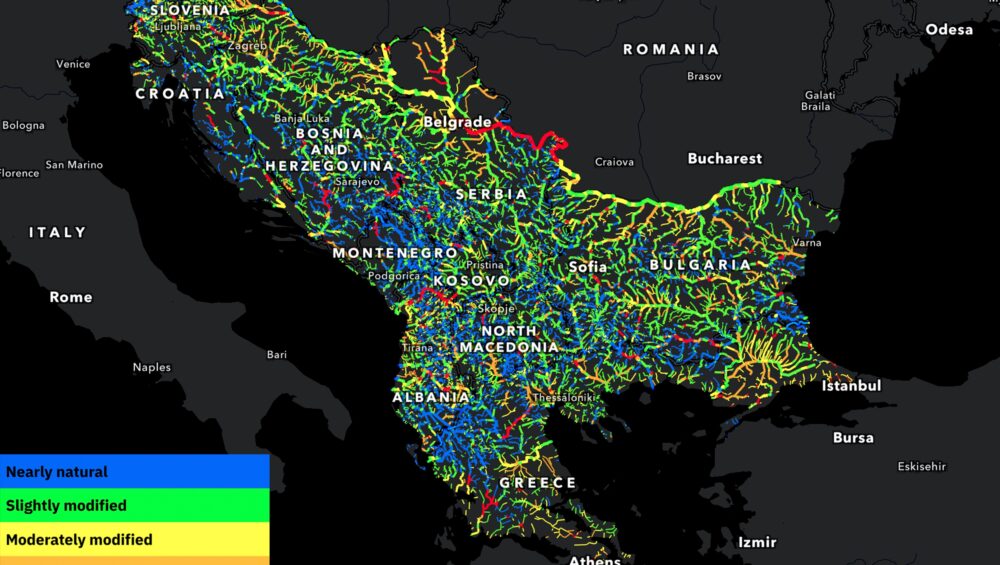
Hydromorphological assessment and 13-year trends
The first comparable regional assessment in over a decade documents the deterioration of Europe’s last wild rivers, with pristine stretches dropping from 30% to 23% since 2012 – a staggering loss of 2,450 river kilometres. Albania’s rivers have deteriorated faster than those of any other Balkan country, largely due to hydropower and river regulation.
Vienna/Radolfzell, January 21, 2026 – A comprehensive new assessment of hydromorphological conditions across the Balkans has revealed a dramatic and accelerating deterioration of the region’s renowned pristine waterways. The Hydromorphological Status of Balkan Rivers 2025 report, authored by Dr Ulrich Schwarz of Fluvius Vienna and commissioned by EuroNatur and Riverwatch as part of the Save the Blue Heart of Europe Campaign, assessed 83,824 km of rivers across 11 countries, revealing that the percentage of nearly natural rivers has declined from 30% in 2012 to just 23% in 2025 or 2,450 rkm, while severely modified river stretches have increased.
Balkans overall: A downward trend
The study reveals a troubling regional pattern:
● River conditions across the Balkans have declined steadily since 2012.
● Larger rivers remain the most impacted due to dams, channelisation, and sediment disruption.
● Larger rivers remain the most impacted due to dams, channelisation, and sediment disruption.
● Since 2012, river impoundments have increased by 18% (from 2,224 to 2,626 rkm).
● Since 2012, river impoundments have increased by 18% (from 2,224 to 2,626 rkm).
Smaller headwater streams are generally in better condition, but pressures are spreading. Hydropower development remains the key driver of degradation. Other major pressures include water abstraction, sediment extraction, and infrastructure construction. Conservation efforts have successfully protected approximately 900 kilometers of rivers, primarily by halting hydropower dam projects.


