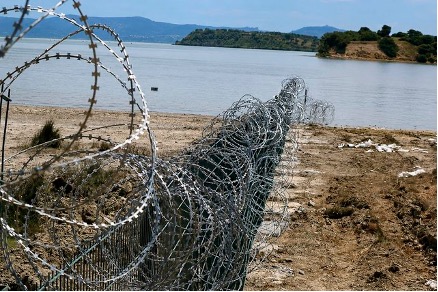
++The Flamingo Revolution challenged the physical fence; the MEPs were stopped by a fence of protocol
By Olsi Nika, EcoAlbania
The visit to Zvërnec on 22 September should have given representatives of the European Parliament an opportunity to see firsthand the interventions that have fuelled months of public protest. Instead, a carefully arranged itinerary took them from the Zvërnec Monastery out to sea, while the area that had prompted the visit remained beyond a new fence, this time made not of iron, but of protocol.
In late May, the residents of Zvërnec faced a wire fence restricting access to part of the coast where works had begun. The confrontation at that fence helped ignite the public protests that later took shape as the “Flamingo Revolution”. Images of protesters facing the barrier and its barbed wire were captured by Albanian and international media and circulated the world.
Almost four months later, on 22 September, representatives of the European Parliament arrived in Zvërnec as part of the EU–Albania Stabilisation and Association Parliamentary Committee meeting, held in Tirana on 21 and 22 September.
According to EcoAlbania’s observations on the ground, three MEPs took part in this part of the visit, accompanied by three members of parliament from the governing majority and one from the opposition. The expectation was that they would have an opportunity to see firsthand the interventions behind one of the most significant environmental and civic conflicts in Albania’s post-communist history.
But in Zvërnec, it became clear that there was a second fence. It was not made of iron and had no barbed wire. It was a fence of protocol, built into the itinerary and very carefully from Albanian MPs of the governing majority.
A carefully organised disorganisation
The visit began at the Zvërnec Monastery, where the MEPs learned about the history and heritage of the religious site. A meeting with village residents was then planned, but their reaction and protest prevented it from proceeding as envisaged. The residents’ presence and the tensions during the visit were also reported publicly that day.
One might have expected the delegation to go next to the heart of the dispute: the site where machinery had moved in, where concerns have been raised about sand dune and forest habitats, and where visitors could see for themselves what has been debated for months in Tirana and Brussels. But the itinerary had other plans.
The visit continued with a boat trip in the waters between Zvërnec and the island of Sazan. That brought the delegation’s time in the area to an end.
From the outside, the schedule might have looked disjointed. Judged by its outcome, however, EcoAlbania sees it as a carefully organised disorganisation: a sequence of activities that used up the available time while leaving the most important site outside the visit.
There is no need to speculate about the organisers’ motives to recognise the result. The MEPs came to Zvërnec to learn about a conflict rooted in a specific place, but left without seeing that place for themselves.
From the sea, the forest looks calmer
The 22 September itinerary did have one undeniable advantage: from the sea, the forest looks much calmer.
The dunes also look less disturbed from the Monastery, while the tracks left by machinery have a useful habit of disappearing when the observer is far enough away.
That is precisely the absurdity that makes the visit troubling. A boat trip may be an excellent way to appreciate Zvërnec’s landscape, but it is a poor way to assess interventions in habitats on land. If the concern is about dunes, forest and the physical transformation of a protected area, verification requires going to the site not merely viewing it from a distance.
And the three MEPs had not come as tourists. They belong to an institution that, just three months earlier, had spoken with unusual clarity about Vjosa–Narta and the legal amendments that opened the way for interventions of this kind.
Outside of the itinerary, within the resolution
On 17 June 2026, the European Parliament adopted its report on Albania by 483 votes to 103, with 70 abstentions.
In the adopted text, Parliament expressed serious concern about developments in the Vjosa–Narta protected area and the practical consequences of legal changes for territories of recognised ecological value. It called for an immediate moratorium on new permit procedures, works and development interventions in protected areas until the incompatible provisions of the amended law on protected areas are repealed and full compliance with EU standards is ensured.
That is why what is happening in Pishë-Poro–Nartë can no longer be treated simply as a local dispute between a tourism project and environmental organisations. The issue is now part of Albania’s EU integration process and a particularly difficult one.
Under the negotiating position for Chapter 27, on environment and climate change, one of the closing benchmarks expressly requires Albania to continue aligning its nature-protection legislation with the EU acquis. This includes repealing the incompatible provisions introduced through the 2024 amendments to the Law on Protected Areas, Law No. 21/2024, and ending the legal regime established by the 2015 legislation on strategic investments.
The European Commission reaffirmed this position in August 2026, emphasising that the Chapter 27 closing benchmarks require the repeal of those incompatible provisions and that Albania must demonstrate its capacity to protect habitats, species and future Natura 2000 sites.
This is therefore more than a law opposed by environmental organisations, residents or protesters. Correcting the 2024 amendments has become a concrete obligation on Albania’s path towards the European Union.
The protocol trap
This gives the visit of 22 September a wider significance.
It is paradoxical that the European Parliament has included Vjosa–Narta in its resolution, and that the European Commission has linked amendments to the law on protected areas to the closing benchmarks for Chapter 27, yet representatives of the European Parliament could travel hundreds of kilometres to Albania and all the way to Zvërnec only to be stopped in the final kilometre.
The physical fence that sparked the protests was visible. It had wire, posts and guards. The fence of 22 September was far more elegant: it came with a schedule, protocol, stops and a somewhat romantic boat trip.
But the outcome was much the same. The boundary between the European representatives and the place they needed to see remained uncrossed.
That should concern the MEPs themselves. A parliamentary visit has value precisely because representatives should be able to form an independent judgement by seeing the facts and hearing from those involved. When an itinerary determines not only where they go but also what they do not see, protocol ceases to be merely a means of organisation and risks becoming a filter on reality.
Albania has reached a stage in its EU integration process where the gap between declarations and implementation will matter more and more. Protected areas are not decorative features, nor obstacles to be bypassed in the name of development. They are a concrete test of the country’s ability to meet the standards it has accepted as conditions for joining the European Union.
Another visit to Pishë-Poro–Nartë would therefore be welcome this time with the community, experts and environmental organisations present, and with the site of the interventions on the itinerary.
Fences can take many forms. European integration should, among other things, mean being able to cross them.


