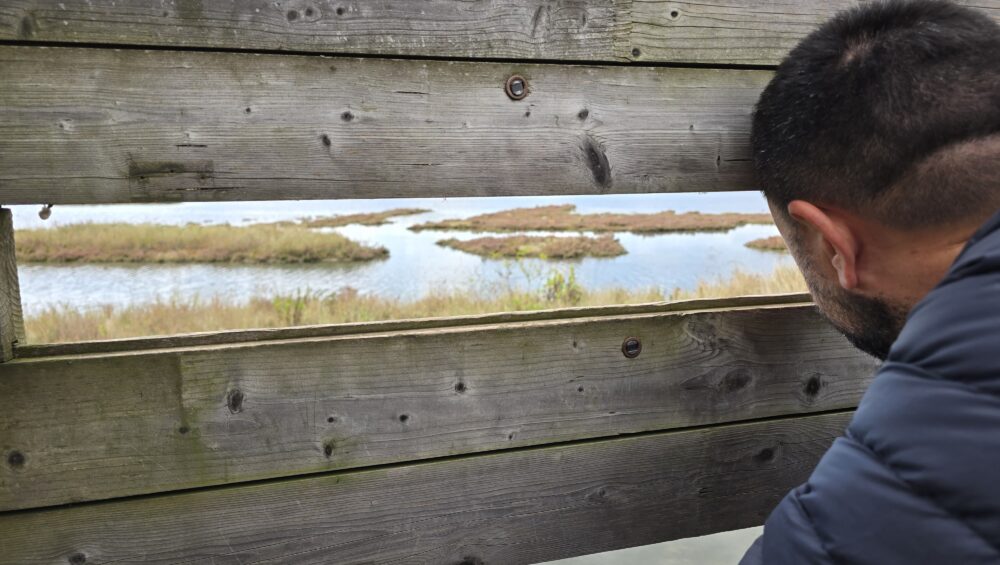
Sixteen representatives from Albania visited protected areas in the Northern Adriatic, exploring different management approaches, habitat restoration practices, and models of cooperation with local communities.
Izola, Slloveni – Trieste and Grado, Itali | 19–22 tetor 2026
How are protected areas managed in practice? How can biodiversity conservation be balanced with visitor management and tourism development? And what role do local communities play in protecting nature?
How can a wetland be rescued from degradation and transformed into a conservation success story? What role can civil society organisations play in the management of protected areas? And how can biodiversity conservation, tourism, and local economic development be brought into balance?
These were some of the key topics explored during the study visit organised by EcoAlbania in Slovenia and Italy, from 19 to 22 October 2026.
The visit brought together 16 participants from Albania, including representatives of civil society organisations, activists and nature enthusiasts, rangers from the Regional Administrations of Protected Areas (RAPAs), and representatives of other public institutions, including the National Inspectorate for Territorial Protection (IKMT). The aim was to gain first-hand insights into good practices in protected area management and the sustainable development of surrounding areas.
The study visit focused on the northeastern part of the Gulf of Trieste and the Northern Adriatic region, covering protected areas in Slovenia and Italy. Through guided visits, presentations, and discussions with representatives of institutions responsible for nature conservation, participants had the opportunity to explore different approaches to habitat management, nature monitoring, and visitor management.
Through field visits, presentations, and discussions with representatives of organisations and institutions responsible for nature conservation, participants explored different practices in habitat management, biodiversity monitoring, visitor management, and cooperation between public and non-governmental actors.
The study visit was organised within the framework of the PAMANCA project – “Protected Areas Matter – Advocating for Nature Conservation in Albania”, funded by the European Union. The project aims to strengthen biodiversity conservation and the governance of protected areas in Albania through greater transparency, monitoring of public policies, and enhanced involvement of civil society in decision-making processes.
Škocjanski Zatok: When Citizen Engagement Becomes the Starting Point for Nature Conservation
One of the most compelling stories shared during the study visit was that of the Škocjanski Zatok Nature Reserve, located near the city of Koper in Slovenia.
Covering an area of approximately 122 hectares, the reserve is an important wetland for biodiversity, particularly for birds and other species that depend on these habitats.
Its conservation history shows that the designation of an area as protected is not always the starting point for nature conservation. In the case of Škocjanski Zatok, civil society mobilisation played a crucial role in response to the threat of degradation and plans for industrial and commercial development in the area.
In 1993, the Slovenian organisation for birdwatching and bird research, DOPPS – BirdLife Slovenia, launched a campaign to protect the wetland, which included a petition that gathered around 7,000 signatures. Following these efforts, the area was designated a nature reserve in 1998. In 1999, its management was entrusted to DOPPS, marking an important example of a civil society organisation taking on the direct management of a protected area.
Through habitat restoration interventions, including projects supported by the European Union’s LIFE Programme, the reserve has developed into a place where nature conservation, scientific monitoring, environmental education, and organised public visits go hand in hand.
During the guided visit, participants learned about the reserve’s history, habitat restoration measures, and visitor management practices.
The experience of Škocjanski Zatok demonstrates that citizen engagement can be decisive in protecting nature, while long-term management requires expertise, resources, and sustained cooperation.
Miramare: Marine Biodiversity Conservation Through Science and Cooperation
he programme continued at the Miramare Marine Protected Area, near Trieste in Italy, one of the country’s pioneering models of marine conservation.
Established as a marine conservation initiative in 1973 and officially designated as a State Marine Nature Reserve in 1986, Miramare is managed by WWF Italy.
During the visit, the Albanian delegation attended presentations by the reserve’s management team and monitoring specialists, gaining insights into its management approach, research activities, and efforts to conserve marine biodiversity.
Particular attention was given to the role of monitoring and scientific data in assessing ecosystem conditions and informing decision-making. Discussions also highlighted the importance of environmental education and cooperation with public institutions, universities, and other stakeholders.
Miramare offers an example of how an environmental organisation can play a direct role in managing a protected area, in cooperation with the relevant authorities and the scientific community.
This model also raises an important question for Albania: how can cooperation between public institutions, civil society organisations, and experts be strengthened to ensure that protected area management increasingly relies on data, monitoring, and the evaluation of results?
Isola della Cona: A Model Combining Public Management, Scientific Expertise, and Cooperative Involvement
On 21 October, participants visited Isola della Cona, part of the Isonzo River Mouth Nature Reserve, in the Friuli-Venezia Giulia region of Italy.
The wetlands, reed beds, wet meadows, and open water areas provide important habitats for numerous species, particularly migratory and resident birds. Ecological restoration and active management have contributed to conserving these habitats and developing the area as a destination for birdwatching and environmental education..
An interesting feature of this model is the way management responsibilities are organised. Alongside the role of public authorities and the technical and scientific support provided by the Isola della Cona Biological Station, the Rogos cooperative is involved in the operational management of the area, contributing to the provision of services and the organisation of visitor activities.
During the visit, participants learned about the organisation of the reserve, visitor management, and the relationship between habitat conservation and nature-based tourism.
This model illustrates how the management of a protected area can involve different stakeholders with distinct responsibilities: public authorities providing governance, experts offering scientific support, and local actors delivering services and operational activities in line with conservation objectives.
The experience offers valuable insights into opportunities for cooperation in protected areas, where biodiversity conservation needs to go hand in hand with well-organised visitor activities and services that support a responsible nature experience.
Marezige: Local Development Beyond the Boundaries of Protected Areas
The study visit also included Marezige, in Slovenian Istria, an area where agricultural traditions, local production, and tourism come together.
Through an exploration of the area and a discussion with a representative of the nature conservation authority responsible for the wider Slovenian Istria region, participants had the opportunity to reflect on the connections between landscape, the local economy, and tourism development.
Marezige is not a protected area, but its inclusion in the programme broadened the discussion beyond the administrative boundaries of nature reserves. Agricultural traditions, local products, and tourism activities can all contribute to preserving the area’s identity and creating economic opportunities for the local community.
For areas surrounding protected territories, cooperation with farmers, producers, businesses, and local communities can help build a more sustainable relationship between nature conservation and economic development.
What Can These Experiences Bring to Albania?
The visits to Slovenia and Italy presented different management models, but also highlighted several common elements: civil society engagement, the use of scientific knowledge, habitat restoration, ongoing monitoring, environmental education, and cooperation with local stakeholders.
The story of Škocjanski Zatok highlights the importance of citizen mobilisation in nature conservation. Miramare demonstrates how an environmental organisation can be involved in the management of a marine protected area, while Isola della Cona offers an example of cooperation between public authorities, scientific experts, and a cooperative engaged in operational management.
For Albania, these experiences provide an opportunity to reflect on several key questions:
- Civil society participation: How can the role of environmental organisations in monitoring, protecting, and managing protected areas be strengthened?
- Evidence-based management: How can scientific monitoring and the evaluation of results be used more effectively to inform decision-making?
- Cooperation with local communities: How can local stakeholders be involved in ways that support both nature conservation and sustainable development?
- Visitor management: How can tourism be organised in a way that enhances appreciation of nature without putting habitats and biodiversity at risk?
These models cannot be transferred automatically from one country to another. Their application requires an assessment of the legal framework, institutional capacities, financial resources, and the specific needs of each protected area in Albania. Nevertheless, learning from different European experiences helps identify practices that can be adapted to the Albanian context.


