++ Following the fencing-off and protests, scientists speak from the field: Pishë Poro–Narta cannot withstand urbanization
++ Amid tensions over the Vjosa resort project, scientists raise the alarm: Damage has already begun
Tirana, 21 June 2026 – A group of Albanian and international scientists conducted a field mission on 19–20 June 2026 in the Pishë Poro–Narta Protected Landscape, located in the Vjosa River Delta, where one of the largest tourism developments planned for the Albanian coast is proposed. The expedition was organized in the context of preliminary construction activities that began on 5 May 2026 and aimed to provide a rapid, independent, professional and evidence-based assessment of the current condition of the area, its natural values and the environmental impacts of interventions undertaken to date.
The mission focused on documenting the main habitats and ecological values of the Pishë Poro–Narta complex, identifying species of national and international importance, and assessing the area’s role in maintaining coastal biodiversity and migratory bird flyways. Particular attention was paid to the ecological integrity of the interconnected lagoon–salt marsh–dune–forest–river–sea system, a unique complex of transitional ecosystems whose functioning depends on highly delicate and interrelated natural processes. The visit follows the commencement of preliminary construction works in May 2026, which triggered strong reactions from local communities, civil society organizations, environmental experts and the wider public. Protests that began in the area in mid-May subsequently spread to Tirana, other Albanian cities and the Albanian diaspora.
Over the past decade, the Vjosa River system has received considerable international attention and strong support from the scientific community due to its outstanding near-natural condition, particularly its largely undisturbed hydro-morphological dynamics and its exceptional biodiversity. Its value as a unique natural heritage site has been recognized by the Albanian Government through the establishment of the Vjosa Wild River National Park in 2023.
However, the delta region and its wider surrounding landscape have not yet been included in this protection framework.
Field observations suggest that the preliminary interventions have already caused significant impacts on natural habitats. Preliminary findings include:
- Damage to nesting habitats of the loggerhead sea turtle (Caretta caretta), a globally threatened and protected species, resulting from heavy machinery operations along the beaches of Dajlan and Portonova;
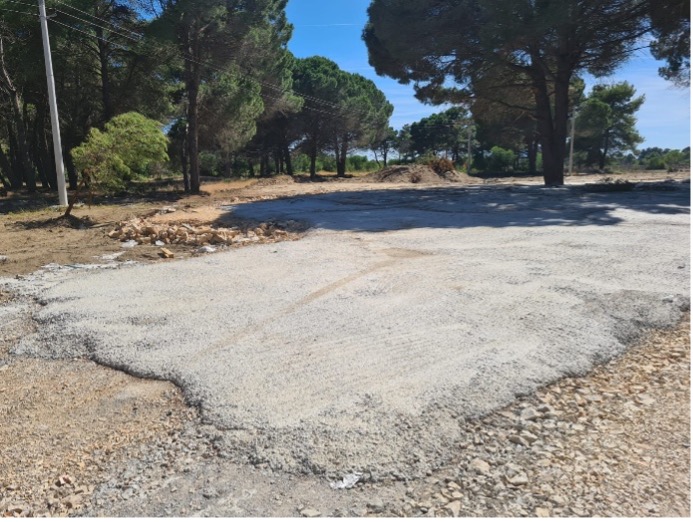
- Impacts on sensitive dune systems, which constitute priority habitats for both Albania and the European Union, due to the deposition and compaction of construction materials used for internal access roads;
- Interventions in the Portonova channel, with the potential to alter the natural exchange of water between the lagoon and the sea, a process essential to the ecological functioning of the entire wetland complex;
- Habitat fragmentation and increased disturbance to bird species that depend on the area for feeding, resting and breeding;
- Increased anthropogenic pressure on an area of high national and international importance for nature conservation.
Prof. Friedrich Schiemer of the University of Vienna highlighted the outstanding importance of the Pishë Poro–Narta complex within the Mediterranean context, emphasizing that it represents one of the best-preserved lagoon systems in the entire Mediterranean Basin. According to him, the diversity of habitats and the high degree of intact ecological processes confer exceptional scientific and conservation value to the area. “The protection of the Vjosa Delta is an urgent matter. Scientific studies have shown that it is one of the best-preserved deltas in the Mediterranean, supporting an extraordinary mosaic of habitats and ecological functions. Today, this unique ecosystem faces serious threats from large-scale tourism developments that could irreversibly damage its natural integrity. We call for the cancellation of destructive development plans, the integration of the delta into the Vjosa Wild River National Park, and the promotion of a sustainable tourism model that respects the ecological limits of the area,” stated Prof. Schiemer.
Prof Perikli Qirjazi stated that “The Vjosa–Narta area contains three natural monuments of exceptional scientific and ecological value: the sand dunes of Narta, which are unique in the Mediterranean; the Narta Lagoon, a freshwater-dependent ecosystem of outstanding importance; and the molasse hills of Zvërnec, geological formations that were once separate islands. These natural monuments are treasures of nature, living archives that tell the story of coastal evolution, climate change, and natural processes over centuries. They serve as open-air laboratories for scientists and students and deserve the highest level of protection. Their destruction through intensive development would represent a major loss not only for Albania, but for the natural heritage of the entire Mediterranean.”
Participating scientists stressed that the value of the area lies not only in individual species but, above all, in maintaining the integrity of a complex system of transitional ecosystems, where the lagoon, salt marshes, dunes, forest, river and sea function as parts of a single interconnected whole.
In this context, Prof. Aleko Miho of the University of Tirana underlined that the ecological balances sustaining these systems are exceptionally fragile and that intensive urban development is incompatible with the conservation objectives of protected areas. “Transitional ecosystems such as Pishë Poro–Narta are the result of natural processes that have evolved over thousands of years. The functional links between the lagoon, salt marshes, dunes, forest and sea create highly delicate ecological balances that can be irreversibly disrupted by human interventions, especially those of an urban character. The construction of large-scale tourist resorts within protected areas is incompatible with the long-term conservation of these ecosystems and risks fundamentally transforming their natural character and functioning,” said Prof. Miho.
The Pishë Poro–Narta Protected Landscape is among Albania’s richest biodiversity areas and enjoys recognition under several international conservation frameworks. The site is part of the Emerald Network and has been identified as a candidate area for inclusion in the European Natura 2000 network upon Albania’s accession to the European Union. Its importance extends beyond national borders, particularly with regard to the conservation of migratory and waterbird populations.
Prof. Ferdinand Bego said “During our two-day visit to the area, we witnessed firsthand how the dunes have been flattened and how these interventions are being presented as a model of coexistence between development and nature. Yet much remains undisclosed. Beyond the claims that ‘there is no project,’ what can be observed on the ground and in the development plans points to a large-scale urbanisation process packaged under the label of ‘luxury resorts.’ In reality, these projects would replace landscapes shaped over thousands of years with concrete and infrastructure. This is particularly alarming for a country aspiring to European integration and claiming alignment with European environmental standards. We are losing irreplaceable habitats, biodiversity, and natural laboratories that should serve current and future generations. No matter how attractive the branding may sound, whether marketed as the ‘Dubai’ or ‘Maldives’ of Albania, the real loser will be the public and the country’s natural heritage. We were proud when the Vjosa was declared a National Park, but protecting the river while sacrificing its delta means giving away a natural treasure for the benefit of a few.”
In this context, Dr. Taulant Bino of POLIS University emphasized that the Pishë Poro–Narta complex represents a key node along the Adriatic–Ionian migratory flyway and provides irreplaceable habitats for feeding, resting, wintering and breeding for hundreds of thousands of birds belonging to dozens of species. “The symbolism of flamingos is important, but this struggle is not only about flamingos. It is also about pelicans, hundreds of other bird species, and the countless forms of life that depend on this ecosystem. This is a movement led by people who want to protect these values and pass them on to future generations. Just yesterday, around 2,000 flamingos were observed in the Vlora Saltworks preparing for nesting, while several other species were recorded in the breeding season, carefully raising their young and relying on stable habitats to survive. These conditions are becoming increasingly threatened by large-scale developments, from Vlora Airport to tourism and infrastructure projects. Similar pressures are affecting other protected areas, including Butrint, Karavasta, Kune-Vain and Velipoja. The fight for Zvërnec is therefore not only a local issue; it is part of a broader effort to safeguard biodiversity in Albania. More than 200 bird species are linked to the wetlands of this area, many of them nationally protected or threatened. If we lose these landscapes, we lose an irreplaceable part of Albania’s natural identity,” stated Dr. Bino.
The participating scientists will continue analyzing the data collected during the expedition and will prepare a detailed scientific report on the state of the area and the potential environmental impacts of interventions undertaken so far. They emphasize that decisions concerning the future of one of Albania’s most important natural landscapes should be based on scientific evidence, the precautionary principle and the preservation of the ecological integrity of this unique wetland complex of national and international importance.
Additional information
The Vjosa Delta is a biodiversity hotspot that contains many (35) habitat types listed under the EU Habitats Directive as being of conservation concern. It is also recognized as an internationally important area for birds and plant diversity. Scientific assessments and comparisons with other Mediterranean delta ecosystems have confirmed its outstanding ecological condition and high conservation value. The Vjosa delta with the Narta lagoon is without par in the whole Mediterranean basin.
Current proposals for rapid, large-scale, luxury tourism development would cause irreversible damage to this unique ecosystem and are therefore unacceptable and in violation of the legal status of the protected area Pishe-Poro-Narte.
The international science community supporting this petition calls for a cautious and balanced development strategy based on the principles of ecological sustainability as recently demanded by the European Parliament.
The signed scientists urge the Albanian Government
To develop a nature friendly eco-tourism that is in line with its extraordinary environmental value
To cancel the destructive projects in the delta area,
To ensure the comprehensive protection of the Vjosa Delta by integrating it into the Vjosa Wild River National Park
Contacts
For further information:
Kaltrina Hyka
[email protected]
+355 69 325 3871
Cornelia Wieser
[email protected]
+43 650 454 4784


